
Middle School · Curriculum by Grade
Not just getting through. Growing into.
Middle school is often treated as something to survive. Here, each year's lessons are chosen for exactly who students are becoming: the questions they're starting to ask, the courage they're ready to build, and the independence they're reaching for. Below is what that looks like in 6th, 7th and 8th grade.
← Back to the Middle School overview“How does it work?”
Sixth graders stand at a threshold. Logical thinking is waking up, and they're ready to understand cause and effect: how Rome was governed, how rocks form, how light and sound behave, how money moves. The year balances hands-on experience with precise, increasingly independent work.
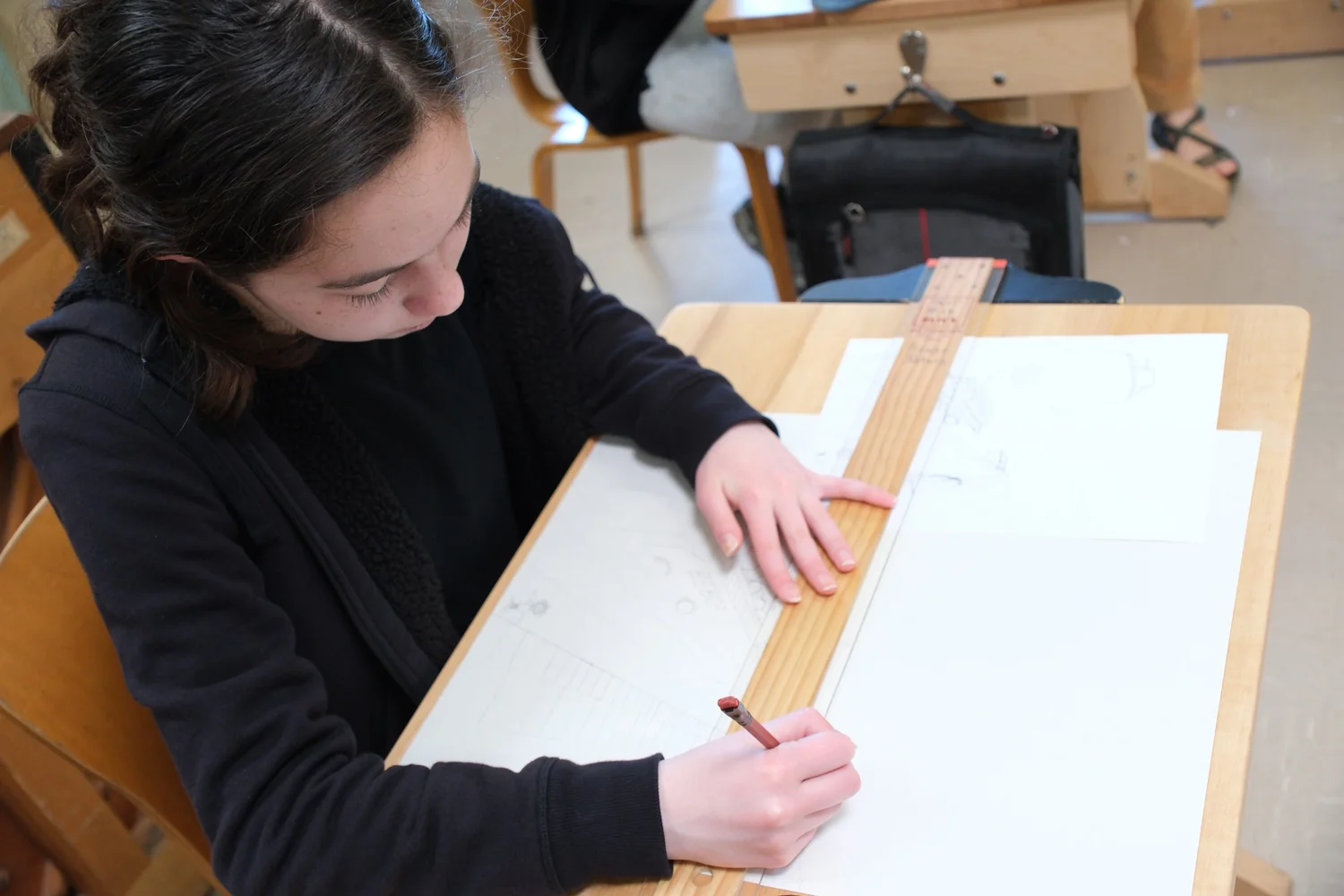
Main lessons
9 blocksGeometry
Compass and straightedge constructions, circle divisions and angles, where precision becomes beautiful design.
Ancient Rome
From Rome's founding myths through the Republic and Empire, with a focus on government and note-taking.
Business Math
Barter, banking, percentages, interest, profit and loss, put into practice running a bake sale and class store.
Geology & Mineralogy
Earth's layers, plate tectonics, volcanoes and the rock cycle, with hands-on study of rocks, crystals and minerals.
Astronomy
The solar system, constellations and eclipses, with night-sky observation to track what's moving overhead.
Physics: Light & Sound
Optics, colored shadows and acoustics, explored through experiment and connected to how instruments make music.
Medieval History
Knights and chivalry alongside Japanese samurai and Bushido, comparing two codes of honor.
Ancient China
Dynasties, the Yellow River and the Silk Road, with hands-on papermaking.
World Geography
Hand-drawn world maps, biomes and regions, and how people and places shape each other.
Year-long classes
- Math: With a math specialist, three times a week
- Spanish: Conversation, grammar, reading and culture
- Music: Part-singing, alto recorder, music theory and orchestra
- Handwork: Advanced knitting and crochet, shaping 3D forms from flat patterns
- Movement: Physical education, eurythmy
Out in the world
- Michaelmas camping trip to Headwaters and Lassen Volcanic National Park, with a hike up 10,000-foot Lassen Peak
- Field trips tied to geology and history lessons
- Contra Dance, winter and spring concerts, Grandfriends' Day
Growing up
The year opens with a trip built around courage: night walks, tree climbing, cold mountain pools and a long climb. Students come home with confidence, new friendships, and a class that knows it can face hard things together.
“What lies beyond?”
Seventh graders are questioning, exploring and testing limits. The year's themes are wish, wonder and surprise: explorers who sailed past the known world, Renaissance artists who saw it new, and scientists who asked how it works. Students meet models of courage and creativity just as they begin finding their own.
Main lessons
9 blocksMedieval Europe
From the fall of Rome and the rise of feudalism to the world that set the stage for the Renaissance.
Age of Exploration
European explorers and their impact on the Americas, with an independent research report, map and portrait.
Inorganic Chemistry
Fire and combustion, acids, bases and the pH scale, and the lime cycle, all through lab experiments.
Physiology & Health
The body's systems, nutrition and personal boundaries, beginning with service at a food bank and ending with a personal health plan.
Creative Writing
Sonnets, limericks and haiku, “show, don't tell,” Sherlock Holmes mysteries and The Merchant of Venice.
Physics
Electricity, magnetism and mechanics, including building a simple electric motor with a high school physics teacher.
Renaissance
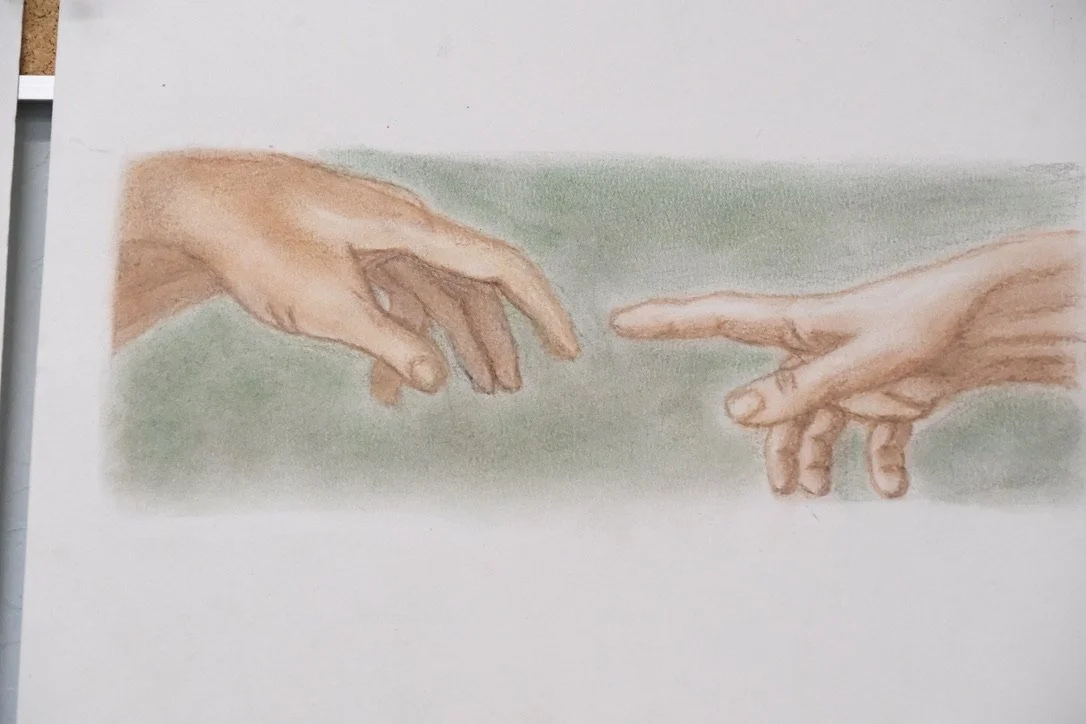
The great masters from Giotto to Raphael, with each student recreating a master work in Renaissance technique.
Geometry & Perspective
Advanced constructions and one- and two-point perspective, applied to architectural design.
Algebra
The unknown quantity, solving equations, the laws of exponents and an introduction to logarithms.
Also through the year: Africa geography and cultural history.
Year-long classes
- Math: Pre-Algebra track, preparing for Algebra I in 8th grade
- Spanish: Spanish 7 & 8, several times a week
- Handwork: Hand-sewn dolls or marionettes, rotating with gardening
- Woodworking: Carved animals, puppets and wooden spoons
- Music & movement: Ensembles, physical education, eurythmy
Out in the world
- Multi-day trip to Synergia Ranch for sustainable-living and teamwork challenges
- Headwaters outdoor education trip in late spring
- Volunteering at Second Harvest Food Bank
- The 7th grade class play
Growing up
Physiology & Health gives students a calm, honest place to talk about their changing bodies, accepting themselves and others, and setting personal boundaries. The class play, where students try out different parts and learn every side of a production, becomes one of the year's great bonding experiences.
“What will I stand for?”
Eighth grade is the culmination of middle school. Students study revolutions and the fight for human rights, take on high school-level math and lab science, lead younger students, and complete a year-long capstone project before graduating.
Main lessons
9 blocksCreative Writing
Short stories and the elements of plot, with students drafting their own endings.
U.S. History: Revolutions
The Dutch and American revolutions, a presidential debate, and research on an invention that changed the world.
Organic Chemistry
Sugars and starches, decoding food labels and making soap, with lab sessions alongside high school faculty.
19th Century & Human Rights
The Civil War, Reconstruction and the Civil Rights Movement, with a research paper on a rights leader.
Anatomy
Bones, muscles, the brain and skin, with students designing exercise routines for specific muscle groups.
Physics
Hydraulics, aerodynamics, and water and air pressure, explored through hands-on lab demonstrations.
Class Play
A full production, from rehearsals and props to music and performance, most recently Aristophanes' The Frogs.
Geometry
Platonic and Archimedean solids, built as clay models and precise compass constructions.
Economic Geography
Global economics, company research, and the cultural and environmental impact of how we farm.
Year-long classes
- Math: Pre-Algebra, or a full year of high school Algebra I
- Spanish: Two levels, focused on conversation
- Handwork: Drafting patterns from their own measurements and machine-sewing garments
- Earth arts: Shaping copper into ladles and rings
- Music & movement: Multi-part recorder, physical education, eurythmy choreography
Out in the world
- Fall camping trip to Point Reyes National Seashore
- 10-day expedition: rafting the San Juan River, then service with Navajo Nation hosts
- Running a Winter Faire stall of handmade goods
- Mentoring 1st grade buddies
Leading & launching
The 8th Grade Capstone combines a physical project, research and service, guided by a mentor and presented to the school community. Students also shadow in the high school, hear from WSP alumni, and give speeches at graduation.
How we assess learning
Clear expectations, and room to grow.
Main lesson books
Each block's book is assessed against clear criteria: accurate writing, labeled diagrams and maps, thoughtful artwork and careful organization.
Mistakes as part of learning
In math especially, errors are expected and used to deepen understanding, so students build confidence along with skill.
Research & presentation
Reports, debates and presentations, from the 7th grade explorer report to the 8th grade capstone, build independence year by year.
Students at the table
In 8th grade, students join their own parent conferences and present their capstone progress.