
Phone-Free Schools: What the Research Shows
By Waldorf School of the Peninsula
Why More Educators Are Saying No to Smartphones on Campus
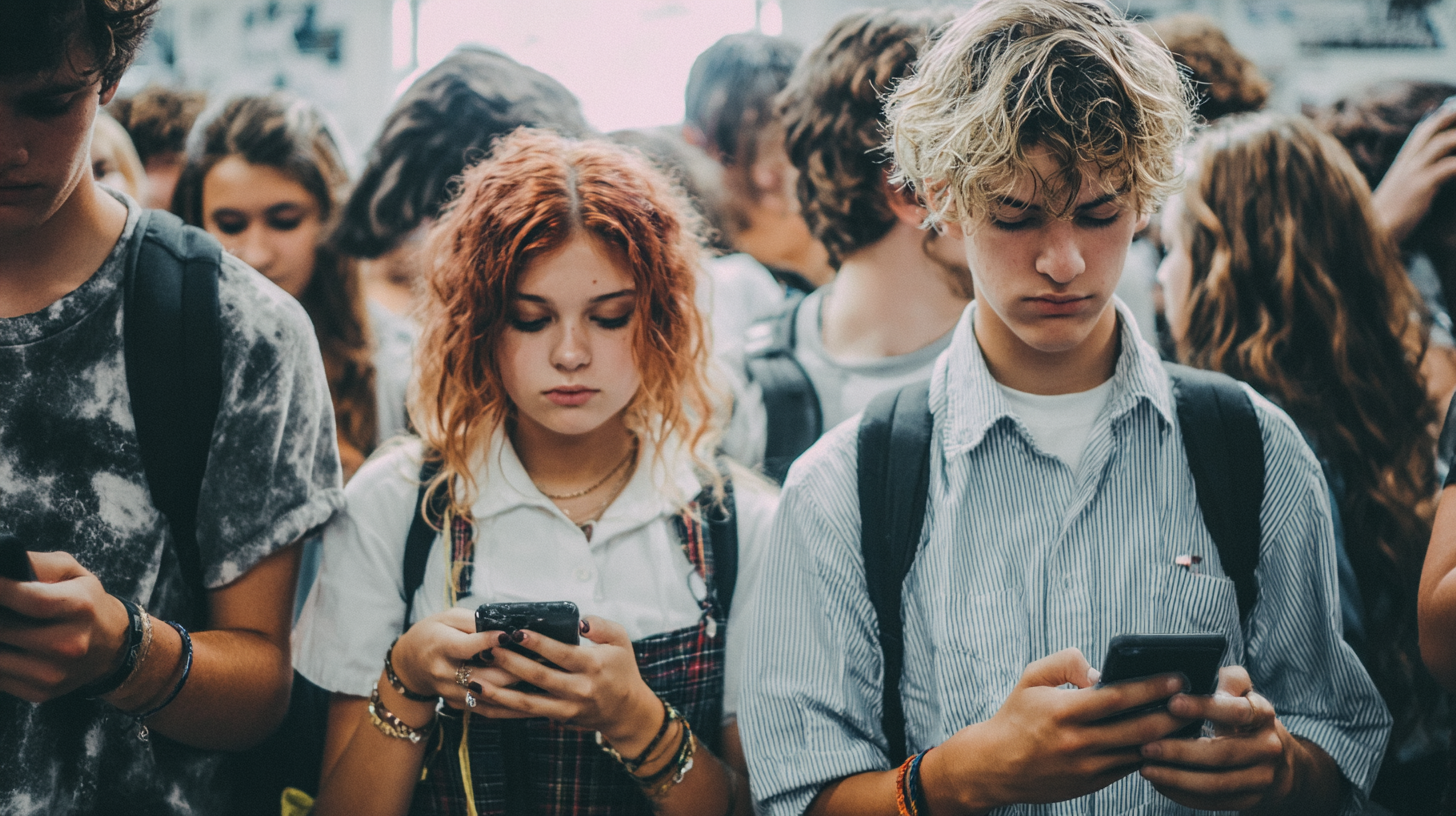
Walk into most high schools during break time, and you'll see something striking: dozens of teenagers hunched over glowing screens, thumbs scrolling, faces lit by blue light, together but profoundly alone.
Now walk into a phone-free school during the same time. You'll see something remarkably different: students talking face-to-face, playing games, laughing, arguing, connecting. They're not more virtuous or different from their peers. They simply don't have smartphones competing for their attention.
The difference isn't subtle. And increasingly, research is showing that what we observe in these contrasting scenes reflects deeper impacts on learning, mental health, and social development.
The Movement Gains Momentum
In the past two years, phone-free schools have moved from fringe experiment to mainstream conversation. High-profile coverage in The New York Times, The Atlantic, and The Wall Street Journal has highlighted schools that have gone phone-free—and the remarkable transformations they've witnessed.
But this isn't just media hype. It's backed by a growing body of research showing that smartphones in schools undermine the very things we hope education will accomplish.
What the Research Reveals
Impact on Academic Performance
A comprehensive analysis published in 2023 examined multiple studies on smartphone use in educational settings. The findings were clear: smartphones in classrooms correlate with lower academic performance, even when students aren't actively using them.
The mere presence of a smartphone within sight reduces available cognitive capacity. In one study, students who had their phones on their desks performed worse on complex tasks than students whose phones were in another room—even though none of the students were using their phones during the tasks.
Think about that for a moment. The phone doesn't have to be used to be distracting. Its presence alone is enough to fragment attention.
Teachers report seeing this every day. Students check their phones an average of 96 times daily according to recent research. In a classroom setting, that's a disruption roughly every ten minutes—before we even count the ripple effects when one student's notification pings and draws the attention of nearby students.
Effects on Mental Health
Perhaps more concerning than the academic impacts are the mental health implications. Research tracking adolescent mental health alongside smartphone adoption reveals a troubling pattern.
Since smartphones became ubiquitous among teenagers around 2012, rates of anxiety and depression among young people have increased dramatically. Teen girls have been particularly affected, with emergency room visits for self-harm doubling between 2010 and 2020.
Jonathan Haidt's recent book The Anxious Generation synthesizes research showing that this isn't coincidental. The "phone-based childhood"—where young people spend formative years constantly connected to social media rather than to the physical world and face-to-face relationships—fundamentally changes how children develop.
Schools that have removed phones report notable improvements in student wellbeing:
Decreased anxiety about social comparison and online drama
Reduced bullying (particularly cyberbullying that previously extended from school into home life)
Improved mood and emotional regulation
Better sleep (since phone removal often reduces late-night screen use)
Social Development and Connection
Sixty percent of teachers report that entertainment media has damaged students' ability to communicate face-to-face, according to recent surveys. When students have constant access to phones, they:
Miss opportunities to practice navigating conflict in person
Avoid potentially awkward but growth-promoting social situations
Develop relationships mediated by screens rather than built through shared presence
Experience FOMO (fear of missing out) that undermines their ability to be present
Phone-free schools report a renaissance of in-person social interaction. Students who initially resisted phone removal later report being relieved. As one student at a school that went phone-free told researchers: "At first I hated it. Then I realized I was actually having real conversations for the first time in years."

Limited distractions = more opportunity for connection.
Attention and Focus
Perhaps the most predictable finding: phones devastate sustained attention. In an era requiring deep focus to master complex skills, students are developing habits of constant distraction.
Seventy-one percent of teachers report that media use has hurt students' attention spans. The constant switching between apps, notifications, and quick-hit content trains the brain for distraction, not concentration.
When schools remove phones, teachers report:
Students can focus for longer periods
Class discussions become deeper and more engaged
Students complete work more efficiently
Less time is spent on behavioral management
One teacher whose school went phone-free described the change: "It's like we got our students back. They're present, they're thinking, they're engaging. I didn't realize how much we'd all adjusted to fractured attention as the norm until I saw what full presence looks like."
The Counterarguments—and What Research Says
"But Students Need Phones for Safety"
This is perhaps the most common objection from parents. The concern is understandable—we want to be able to reach our children in an emergency.
However, research on school safety doesn't support the idea that student phones increase safety. In fact:
During actual emergencies, student phone use can create chaos (overwhelming networks, spreading misinformation, creating distractions)
School office phones remain available for genuine emergencies
Students can have phones available (in lockers or with office) but not on their person
The perceived safety benefit appears to be primarily about parental anxiety rather than actual student safety.
"Students Need to Learn Self-Regulation"
The argument goes: if we ban phones, students won't learn to manage them responsibly. Better to let them struggle with self-regulation while still in school.
But research on adolescent brain development tells a different story. The prefrontal cortex—responsible for impulse control and decision-making—doesn't fully develop until the mid-20s. Asking teenagers to resist devices specifically designed by teams of engineers to be addictive is setting them up to fail.
It's not about building character. It's about matching expectations to developmental capacity.
Moreover, phone-free schools still teach digital citizenship and media literacy—they just do it in controlled settings rather than allowing constant, unmediated access.
"This Is Unrealistic—They'll Need Phones in the Real World"
This concern assumes that not using phones in school means students won't learn to use them at all. But research consistently shows that digital skills are learned remarkably quickly when students are developmentally ready.
What's harder to develop later—and what phone-free schools prioritize—are capacities like:
Sustained attention and deep focus
Face-to-face communication skills
Critical thinking and independent reasoning
Creative problem-solving
Emotional regulation
These foundational skills make students better technology users when they do engage with devices, not worse.
The Transition Period: What Schools Report
Schools that have made this change report that the first few weeks are challenging. Students push back. Some parents complain. Teachers must adjust to new behavioral norms.
But consistently, schools report that after a brief adjustment period:
Student resistance fades (many students express relief)
Parents notice positive changes at home
Teachers report dramatically improved classroom environments
Academic and social benefits become apparent
One principal described it this way: "It's like we lifted a fog. We didn't realize how much the constant phone presence was affecting everything until it was gone."
The WSP Experience: A Long View
At Waldorf School of the Peninsula, we've been phone-free since our founding. We didn't start as a statement about smartphones—the technology simply didn't exist yet. But as smartphones became ubiquitous in society, we've maintained our commitment to phone-free childhood, now backed by research we couldn't have anticipated.
What we observe aligns with what research now confirms:
Students are present. During breaks, they play games, have conversations, read, draw, or simply rest. They're not comparing themselves to curated social media personas. They're not anxiously checking for notifications. They're just... here.
Learning goes deeper. Without the constant possibility of digital distraction, students can engage in sustained, focused work. They can wrestle with difficult concepts without the escape hatch of scrolling away discomfort.
Social skills flourish. Students navigate conflicts face-to-face, learn to read social cues, develop genuine friendships based on shared experiences rather than mediated through screens.
Creativity thrives. Without constant digital stimulation, students experience boredom—and from boredom emerges creativity. They write stories, build things, make music, create art.
What About High School?
The research on phone removal focuses primarily on middle and high schools, where smartphone ownership is nearly universal. The findings are consistent: even high school students benefit from phone-free environments.
At WSP, our high school students (grades 9-12) use technology purposefully for academic work, but personal phones remain off during school hours. Students consistently report that they appreciate this boundary. One senior told us: "My friends at other schools are constantly distracted. I can actually focus and do deep work. It's made me realize how much phones steal from us."
Our graduates enter college and careers fully capable of using technology skillfully—but they approach it as a tool they control, not a compulsion that controls them.
The Broader Question: What Is School For?
Ultimately, the phone-free school movement asks us to reconsider what we want education to accomplish.
If school is primarily about information delivery, then phones are neutral or maybe even helpful—students can quickly look things up, access resources, communicate efficiently.
But if school is about developing human capacities—the ability to think deeply, connect meaningfully, create originally, focus sustainedly—then phones actively undermine our goals.
Research increasingly suggests that the second view is correct. In an age of abundant information but scarce attention, schools may be one of the last refuges where young people can develop the capacities that make us most fully human.
What Parents Can Do
If your child attends a school that hasn't gone phone-free:
Connect with other parents who share your concerns
Bring research to school administration
Advocate for phone-free policies
Consider delaying smartphone ownership (Wait Until 8th is a useful resource)
Create phone-free times at home regardless of school policy
If you're considering schools for your child:
Ask about phone policies
Observe students during breaks—what are they doing?
Talk to current students and parents about phone culture
Consider whether the school's approach to technology aligns with your values
The Path Forward
The research is clear, and it's growing clearer: phones in schools undermine learning, mental health, and social development. The question isn't whether phones affect students—it's whether we're willing to act on what we now know.
More schools are taking this step. But change is hard, especially when it means standing against broader cultural trends. It requires courage from administrators, support from parents, and willingness to weather the initial discomfort.
The schools that have made this choice report that it's among the best decisions they've made. Not because they're anti-technology—many are in communities that embrace innovation. But because they recognize that childhood is the foundation upon which everything else is built.
When we protect that foundation from premature digital intrusion, we give young people the gift of presence, focus, and genuine connection. The research shows that this matters. And increasingly, schools are listening.
Learn More
Interested in a phone-free educational environment?
At Waldorf School of the Peninsula, we've been phone-free since our founding. Our students develop strong foundations in critical thinking, creativity, and human connection before engaging with technology as the powerful tool it can be.
Schedule a call or campus visit to see our approach in action →
Sources & Further Reading
Haidt, J. (2024). The Anxious Generation: How the Great Rewiring of Childhood Is Causing an Epidemic of Mental Illness
Twenge, J. (2017). iGen: Why Today's Super-Connected Kids Are Growing Up Less Rebellious, More Tolerant, Less Happy
Ward, A. F., et al. (2017). "Brain Drain: The Mere Presence of One's Own Smartphone Reduces Available Cognitive Capacity." Journal of the Association for Consumer Research
UNESCO (2023). "Technology in Education: A Tool on Whose Terms?"
Common Sense Media (2024). "The Common Sense Census: Media Use by Tweens and Teens"
American Psychological Association: Research on adolescent mental health and social media use
